
Lesedi, our Uber driver, wants to name his son, ‘Gadija’. I explain to him that it’s a girl’s name. I also explain that I don’t know what it means, only that Khadija (let’s not get into the spelling discrepancies) was the wife of the Prophet Muhammad (PBUH), and that’s what gives the name its significance.
He’s nonplussed; because ‘Lesedi’ is also a girl’s name. And he likes the rhythm of ‘Ga-dee-jah’. I decide not to argue.
Lesedi is taking us to the Liliesleaf Farm in Rivonia, Johannesburg. Its importance in the struggle against Apartheid is lost on me. I just know that it was a farm where many of the Anti-Apartheid guys used to meet. I know it has links to Nelson Mandela.
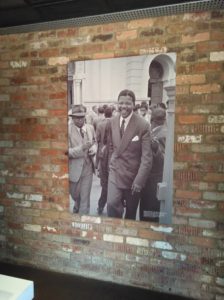
Now before you get at me for the gaping holes in my knowledge of South African history, I must clarify that the history textbooks at school focused on World Wars, and kings and queens. Nothing of the exciting, movie-like scenarios that played out in South Africa, as civilian men and women were forced to take up arms to fight against a racist and oppressive regime.
But a visit to Liliesleaf Farm Museum soon filled some of those gaps.
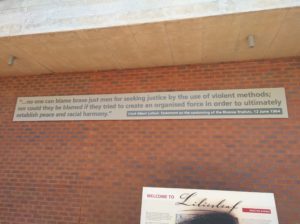
Walking through the entrance of the compound, there’s a tranquility that only a weekday visit to a museum can provide. A gently bubbling stream snakes around the many buildings that serve as portholes to the events that lead to the Rivonia Trial; while flowers, willowy trees, and quotes from notable freedom fighters ease visitors into their journey down South Africa’s liberation history.
The farm, which was also code-named ‘Cedric’, was bought through the South African Communist Party (SACP’s) front company called Navian (Pty) Ltd.
Liliesleaf was far from prying eyes, so it naturally provided a secure location where the underground leadership, including Nelson Mandela and Co, could meet. It was also bought when the ANC decided to move from non-violent resistance, to armed struggle.
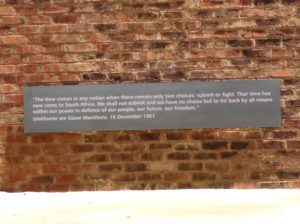 Nelson Mandela, a key ANC figure, took up residence at Liliesleaf in October 1961. And in December of that year, Arthur Goldreich, a member of the SACP, and his family, moved onto the small holding, as the perfect white front for black resistance.
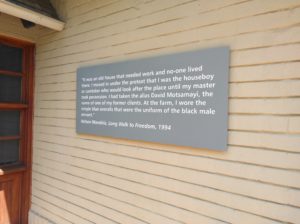
Senior leaders of the liberation movement attended strategy meetings and sought shelter at Liliesleaf. These included Nelson Mandela, Govan Mbeki, Walter Sisulu, Ahmed Kathrada, Joe Slovo, Ruth First, Bob Hepple, Harold Wolpe, and Denis Goldberg. And some of these made up the Rivonia Treason Trialists; the men arrested for conspiring to overthrow the Apartheid government.
Each structure on the farm-turned-museum is dedicated to different aspects of the strategy sessions, and outside influences that shaped the nature of the struggle movement.
But it’s the final building that houses the safari truck used as a cover for smuggling arms that impresses.
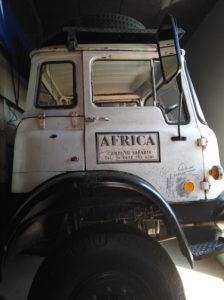
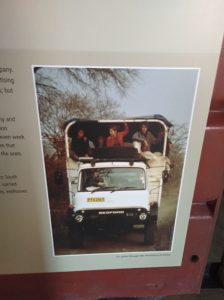
The massive Bedford truck was ‘upgraded’ to hide all manner of weapons in cleverly concealed compartments. So clever, that the clients of “Africa Hinterland – African Overland Expeditions” enjoyed their idyllic African safari blissfully unaware of the arsenal on which they were sitting.
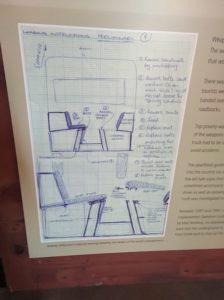
This brainchild of Joe Slovo, started its trips in 1986, and ran up until 1993, making over 40 journeys from Mombasa to South Africa. Each trip carried a ton of AK-47s, pistols, limpet mines, grenades, explosives and ammunition, successfully contributing to the ANC’s armed wing, Umkhonto we Sizwe.
The Liliesleaf Museum, while paying tribute to the men and women who risked their lives for an ideal greater than they could hope to see fulfilled, inadvertently celebrates the beginnings of a multi-racial, multi-faceted South Africa that existed despite the segregation.
It shows the sparks of a people willing to see the beauty in each other’s cultures, and to learn from them. And over fifty years later, an Uber driver from Limpopo, driving in Johannesburg, tells a tourist from Cape Town that her Arabic name is worthy of being carried on in his African family.
We may not be the beautiful rainbow nation envisioned, but we’re getting there.