
Lesedi, our Uber driver, wants to name his son, ‘Gadija’. I explain to him that it’s a girl’s name. I also explain that I don’t know what it means, only that Khadija (let’s not get into the spelling discrepancies) was the wife of the Prophet Muhammad (PBUH), and that’s what gives the name its significance.
He’s nonplussed; because ‘Lesedi’ is also a girl’s name. And he likes the rhythm of ‘Ga-dee-jah’. I decide not to argue.
Lesedi is taking us to the Liliesleaf Farm in Rivonia, Johannesburg. Its importance in the struggle against Apartheid is lost on me. I just know that it was a farm where many of the Anti-Apartheid guys used to meet. I know it has links to Nelson Mandela.
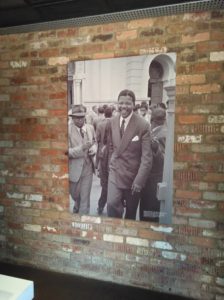
Now before you get at me for the gaping holes in my knowledge of South African history, I must clarify that the history textbooks at school focused on World Wars, and kings and queens. Nothing of the exciting, movie-like scenarios that played out in South Africa, as civilian men and women were forced to take up arms to fight against a racist and oppressive regime.
But a visit to Liliesleaf Farm Museum soon filled some of those gaps.
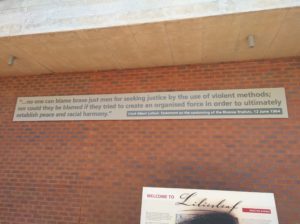
Walking through the entrance of the compound, there’s a tranquility that only a weekday visit to a museum can provide. A gently bubbling stream snakes around the many buildings that serve as portholes to the events that lead to the Rivonia Trial; while flowers, willowy trees, and quotes from notable freedom fighters ease visitors into their journey down South Africa’s liberation history.