2020 – the Life Lesson we Never Thought we Needed

Hobbies provide a diversion from one’s routine. It exercises your brain and body with other skills. Doing manual tasks often helps your creativity grow, which in turn reinvigorates your approach to your usual duties.

The lockdown forced many to find something to divert their energies. Besides the extreme shopping in which many participated (what happened to all those toilet paper hoarders?), some took to learning how to bake bread, others began gardening, cleaning, and finding creative ways of keeping fit.

All that time in doors meant that celebrities had to find other ways to remain relevant, and a cursory look through the podcast section on Spotify will show you just how many celebs have taken on “broadcasting”. The celebrity broadcast essentially means famous people talking to their famous friends about “that time they worked together”, or “that time they worked with [insert celebrity name here].”

Some managed to do it in a way that is not annoying and self-congratulatory, while others (Rob Lowe) did not.

But then there was the jewel of “Staged”. A BBC production filmed, directed, scripted, and acted remotely. This show is beautifully anchored by David Tennant and Michael Sheen (those who watched will know why that sentence is funny). The actors were left to negotiate their family routines and learn how to use recording technologies, and Zoom, to pull this pioneering show off. And they did!

 Sheen and Tennant take the viewer on a Zoom-esque “Waiting for Godot” journey. They depict the uselessness that actors felt during the early stages of the lockdown, and how their livelihoods were affected. Their characters battle listlessness, depression, and ego so convincingly that it endears them to the audience. This is largely achieved through the humanity of their angst.

But that’s how the celebrities got on. How did the rest of us do it? Some worked, others worked from home, and many lost their jobs and so much more. So how did we persevere?

We also attempted bread-making, gardening, cleaning, and inventive ways of keeping fit; all physical activities that allowed our brains to relax while doing menial tasks.

I worked through the hard lockdown, and finally decided to take a break in September. Some things returned to relative normal, but I also needed to shut the world out for a bit.

To effectively achieve this goal, I needed to plan – so how would I do it? And what would I do during that mini break?

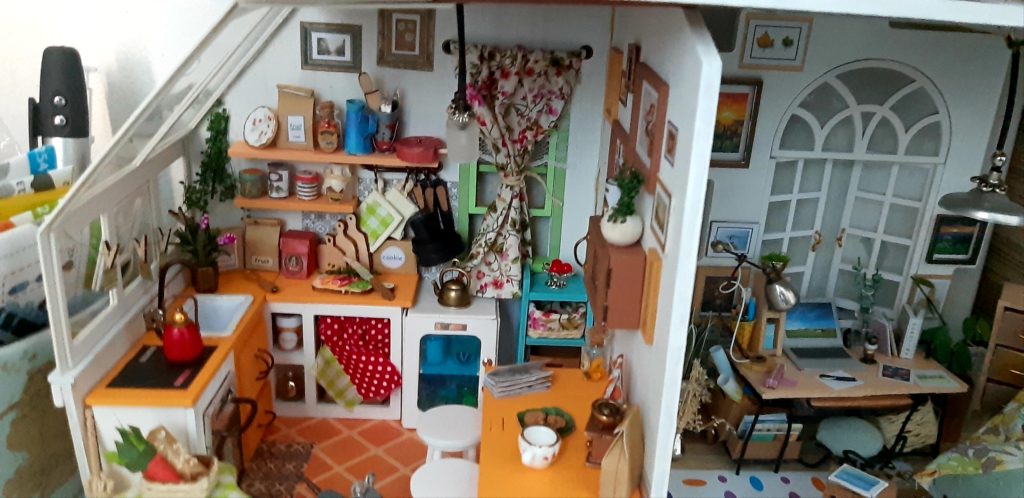
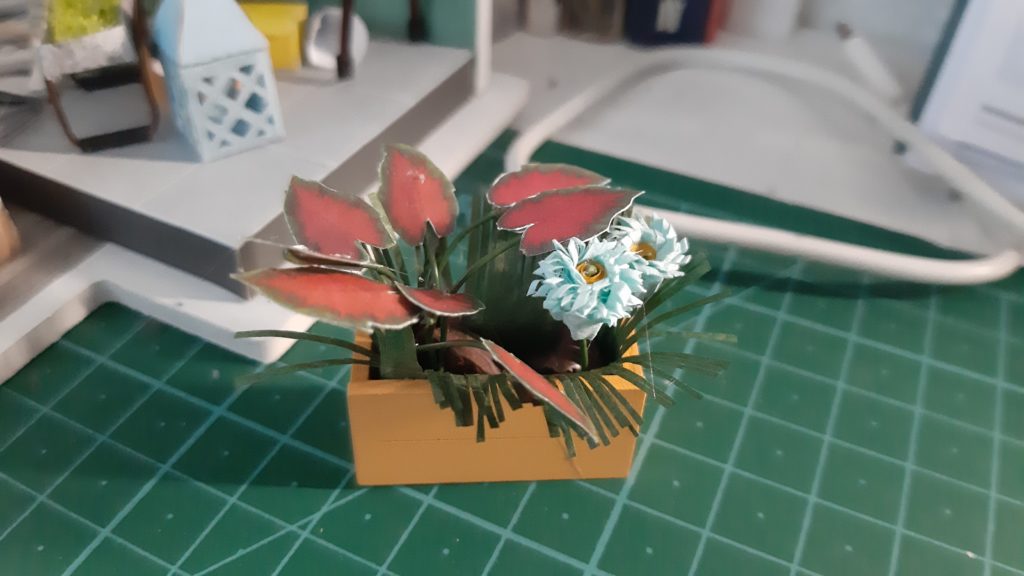
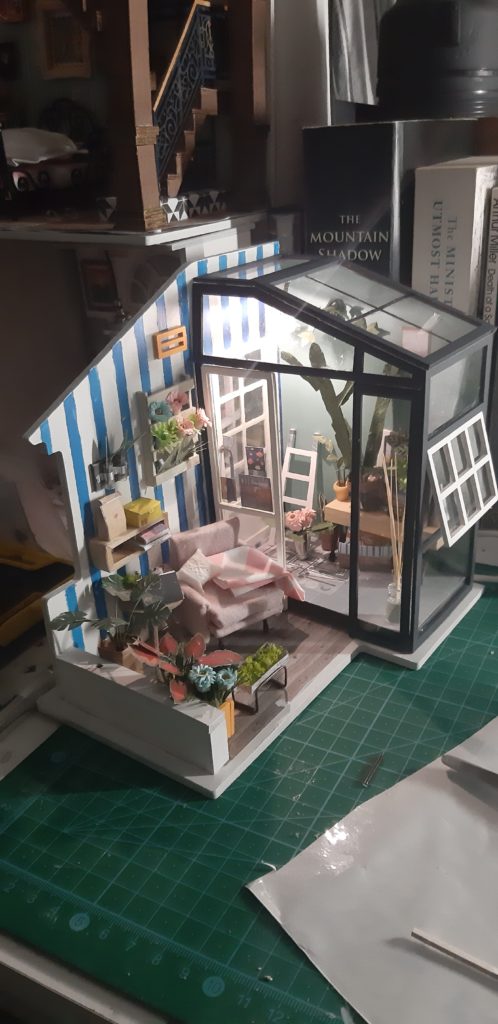
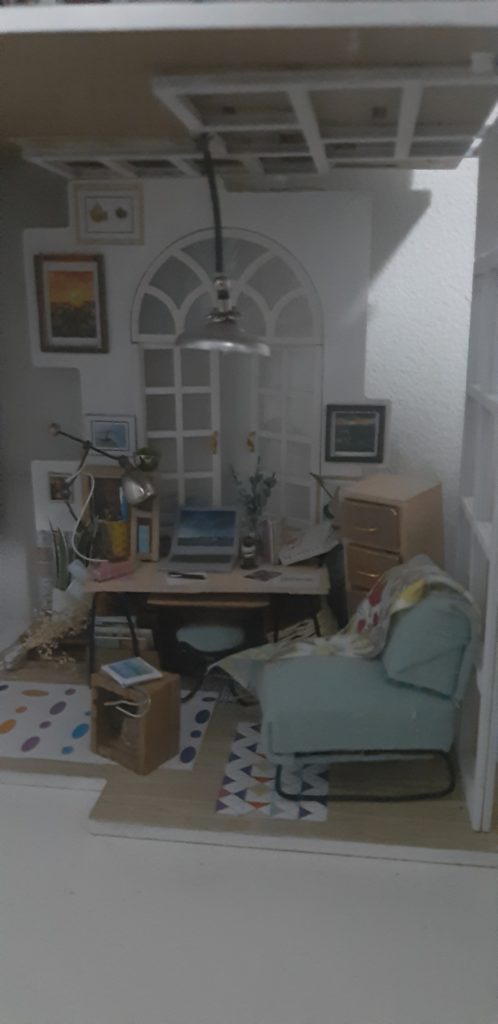
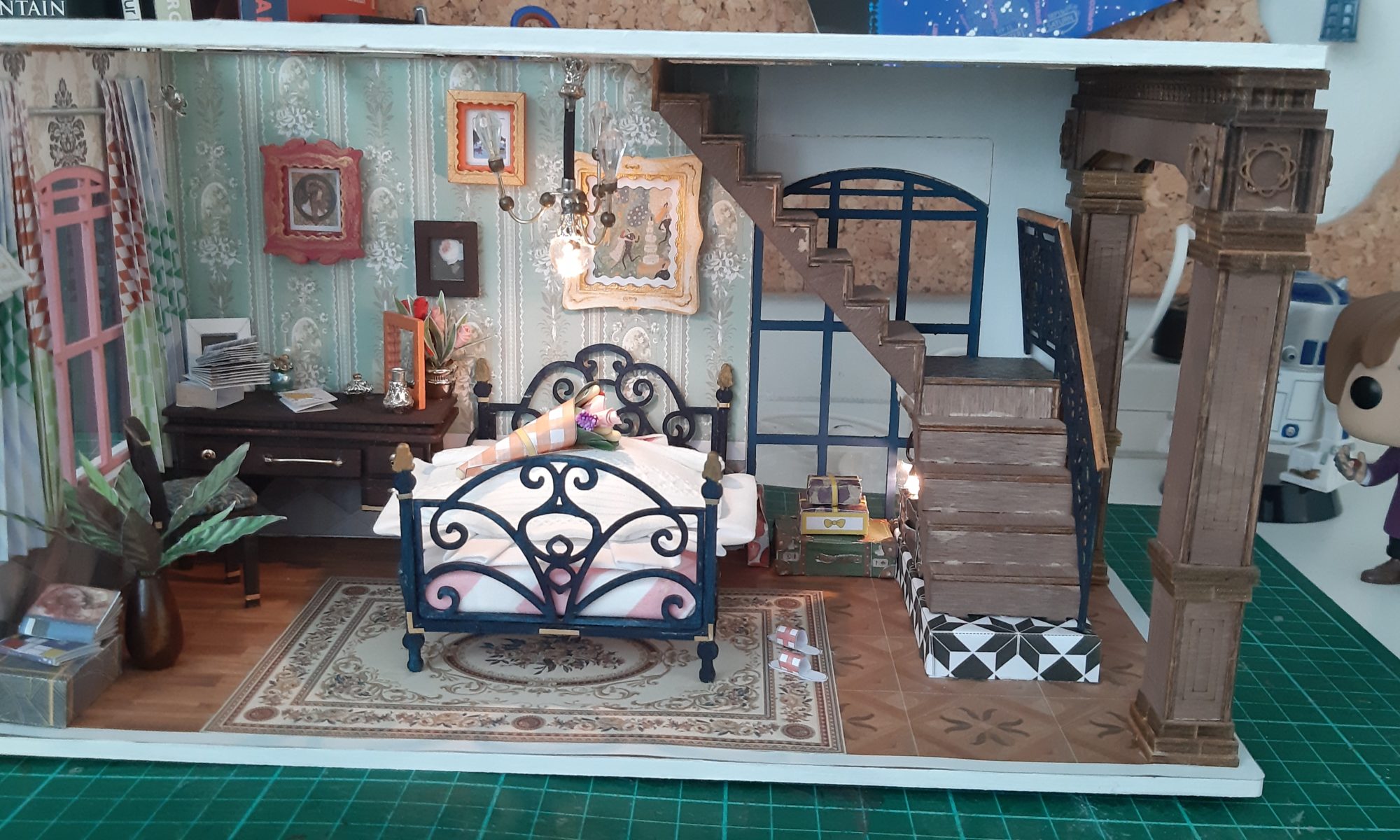
My friend had taken an interest in building miniatures – she’d already completed a miniature bedroom. But she was having trouble with scaling. Her research led her to Robotime kits. These provide you with most of the tools to build a miniature themed room. Some advanced; others suitable for beginners.

We decided to order Soho Time online. And so a new addiction and hobby was born for me. I finished mine in four days.  

I now know what a self-healing mat is. My wire work is improving through each completed kit (so far four). One still left to do, and one to build from scratch.
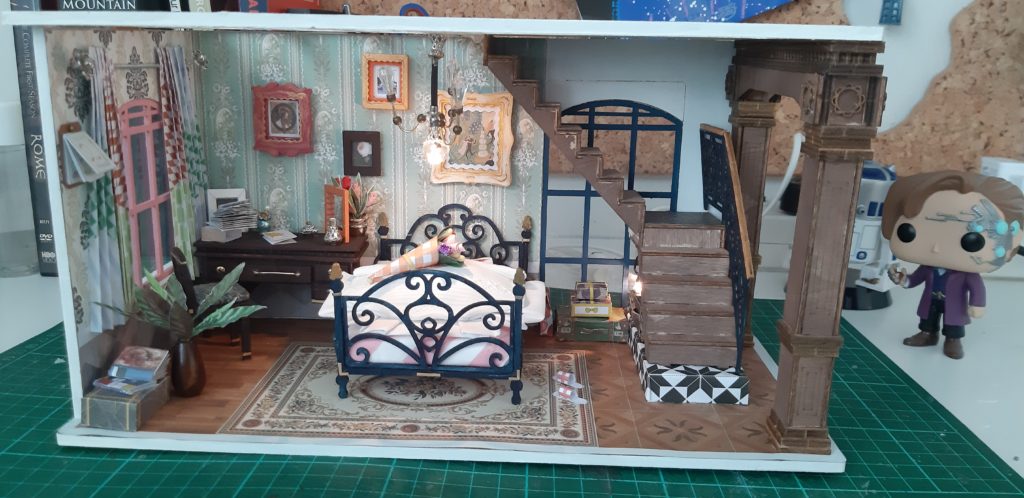
The skill and concentration needed to build these kits has helped me relax, while listening to podcasts. Naturally, I gravitated to the congratulatory content of the celebrity podcast, but that soon led me on to radio drama, audiobooks, Louis Theroux’s podcast, and finally, a history podcast that doesn’t make me question my existence.

While I may be running out of room space for my little crafts, the therapy of creating something, and seeing it through from cardboard to an actual jug, should not be scoffed at.

Time really is relative when you consider what can be created in 30min. I suppose the Doctor was right, “Time is a structure relative to ourselves… Time And Relative Dimensions In Space – it means Life!”

This past year, and the things and skills we’ve learned mean that we cannot cancel 2020 – we’ve probably lived the most in those 10 million months.
The Crust of the Matter

I eat the crust first. If it’s a pie, or pizza, I eat the part with the least amount of flavour first.

It’s the same with cakes and tarts.

My preference is based (pun intended) on these being the driest and least flavoured parts of these dishes.  Especially if it’s shop bought.

There’s no way of knowing if the base will be too doughy, or too thick, so getting that part out of the way helps.

Some may argue to just not eat base at all. But that would be wasteful, and I was raised to finish my food.

The guilt left from not consuming the entire dish may have been engrained by my parents who always ensured that we had wholesome home-cooked meals. And as I reflect on my childhood, the groceries bought to make up these meals were as a result of particular consideration and budgeting.

We didn’t waste in our home.

The meat in our food ensured that we had balanced meals with protein, but I wonder why I still keep the meat for last.

It’s an odd habit. Meat in any dish I eat is always the prize. And I finish the other components first so that the taste of meat lingers a bit longer.

But back to the crust.

Anyone who’s watched the Great British Bake Off knows that the crust at it’s basic level must have a buttery flavour, and be moist enough to complement the filling.

And when you run your fork from the top of the cake down to that crust, you ensure that you get the perfect bite of all the flavours of the dish.

But I know all the good stuff is in the centre. Even with a pizza; it’s the part densely populated with all the gooey or veggie goodness that gets me every time.

That’s where all the flavour is.

It may be a weird logic, but there it is. I also open a chips packet from the bottom.

The reasoning?

I don’t want my last bite of the packet to be crumbs.

I’ve may have elicited a shocked intake of breath from friends, but my logic stands. The last Dorito is more often than not decently sized, covered in flavouring, and most importantly, not sawdust.

The Masked Crusader – one woman’s journey to find the perfect face mask

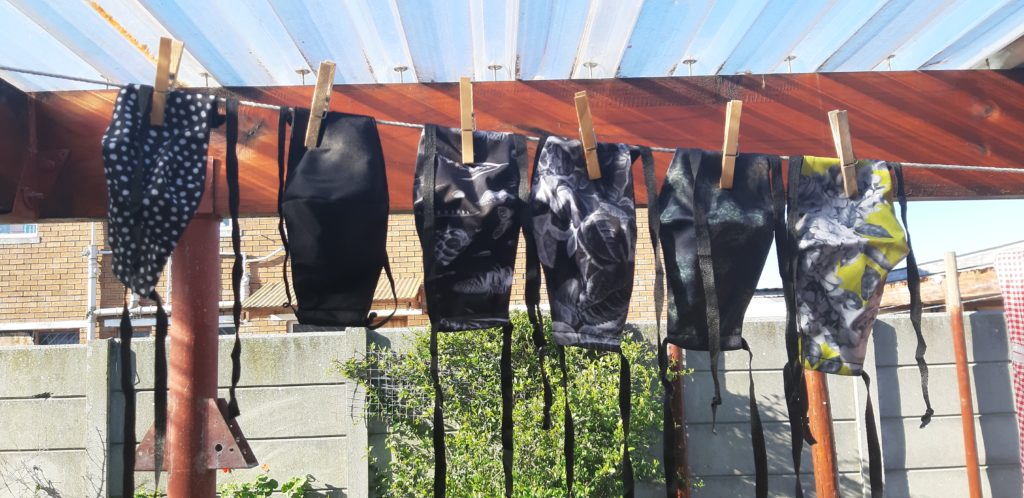
Protection drying on a washing line (www.gadija.co.za)

I have 14 face masks. That’s too much for some. It’s also odd for me as I don’t like wearing one; it feels restrictive, I can’t eat and walk while in a public space, and it leaves indents on my face.  But these inconveniences are nothing compared to the protection these masks provide.

But I get flak for having two weeks’ worth of face protection. It seems excessive, and when wearing a face mask became mandatory in South Africa, I thought I could manage by rotating two throughout the week. The plan was to wash one wear one.

But then I developed mask envy. And the very real problem of spectacle fogging became too much to bear. I had to find alternatives to the two black, elasticated ones I had.

Side note: why do the ear ones cause your specs to fall off your face, and why do your ears resemble Shrek’s when you wear them?

Enter the sponge mask with a vent. Stylish, ear friendly, comfortable, no steamed up specs, and I could breathe deeply without eating the mask. All pluses, but the vent became home to a pool of condensation. And I developed a huge zit on the exact location the vent touched my face. It was not lost on me that wearing a mask would hide said zit, but it also meant aggravating the growing puss volcano on my cheek.

Another problem with the ear masks*,  is that wearing a head scarf with these guys meant having to first mask up and then don the hijab. And putting it on again, while wearing the scarf was annoying, and my specs would once again give in to the Earth’s gravitational pull.

I had to find an alternative to the ear ones.

Enter the stringed cloth face mask. So easy to take off and wear again between the car and public space. It ties over the head scarf – a definite win. But it fit too closely to my mouth. I was not deterred, the lesson was learned.

Now for the elasticated, duck mask. The elastic bands work like the stringed masks, and they provide a nice gap between the face and the cloth. I’d found my favourites. I was done searching.

At this point I should mention that as I progressed through the different types and styles of face masks. The sponge vented one was the most expensive at a cost of R60 each.

I had eight masks, and doing fine until my sister showed me a catalogue of face masks that looked like art on your face. Nothing avant-garde but still beautiful, and they had strings attached (saw the pun, left it in).

I flipped through the catalogue and selected my favourites. My sister placed the order, and a week later, I had my six designer face masks with varying colours and prints. These beauties cost me R80 each, but were well worth it considering that some designers were charging R100 for a plain one.

My new face accessories look good, they fit perfectly, and they tie around my head.

The stringed face masks can be tied at the crown of your head to ensure a snug fit, whereas the elasticated duck masks, while remaining secure on my face, often left a red indent on my nose.

It’s been a strange and uncertain few months, and the search for the perfect mask has offered me a kind of distraction from the stress of the unknown. At least I can control the kind of protection I use. And as that meme says, “treat your masks like you treat your underwear”.

And the similarities are uncanny:

  • make sure it’s clean
  • make sure it fits well but not too tight
  • don’t touch or adjust it, especially in public
  • don’t share it
  • throw it away if it has stains or holes

And like underwear, you should have several face masks for in case you forget (or are too lazy) to wash them.

After all of that I still need to sort out my fogged up specs.

*masks that have elasticated or string loops that fit around your ears

Dignity Costs R 150

It’s unusually damp and grey for a January afternoon in Cape Town, but Michael is hoping to catch a ride from Constantia to inch closer to finding a place to sleep tonight.

Public transport is less frequent on a Sunday, and he is short on cash.

It starts to rain, and the droplets slowly start to seep through his best suit. His hat also starts to weigh heavy on his head. He decides to remove his jacket, as it’s strangely humid for Cape Town.

Michael has taken a bus from his home in Mhlanga, for a job interview at an air carrier in the Cape. He’s in his 50s, but willing to work, and needs the money. He has left his wife at home.

The job pays well enough, but its physical labour; he will need a safe and comfortable place to stay while he saves his money.

Money. He needs R 150 to pay for the shelter in Gugulethu. This money will secure his stay until he begins work at the airline in February. But he doesn’t have it.

He stands on the roadside in leafy Constantia. The rain gently pats his clothes. It bonds with his white shirt. Now it resembles the grey sky. Its midday and he hopes to catch a ride.

A silver Toyota pulls up, and his hope rises slightly.

He tells the driver that he needs to get to Mossel Bay, and could hitchhike there from Somerset West. He says that he knows someone in Mossel Bay who may have the R 150 he needs to secure his stay at a shelter in Gugulethu, but he doesn’t have his phone number.

Michael explains that Zulus always help their own. And he knows a few Zulus in Mossel Bay. The driver of the Toyota says he can only take him as far as Muizenberg. He is grateful.

There are Zulu petrol attendants in Muizenberg. They may be able to help him out with the R 150 he needs.

But he’d have to find a way from Muizenberg to the shelter. The owner is keeping his suitcase, so at least he can travel lightly while he depends on the good will of others.

The ride passes Blue Route Mall, and he decides that this is where he will part ways with the driver. Michael hopes to find his people. The driver gives him some cash, and his hope rises again. Just a few more rands, and he’ll be able to sleep safe and dry this evening.

Practice Makes Habit Makes Perfect – the declutter continues

“It’s messy, not dirty. That’s an important distinction: It’s dust, not dirt.” – Louis to Joe (Angels in America, 1985)

That’s a fairly accurate description of my approach to my room; it’s not dirty, my clothes just need to be packed away.  At least that was my attitude towards the organized chaos that was my room.

But since my last entry on ‘decluttering’ inspired by attn: and Jessica Alba, I’ve started organizing the other elements in my messy cocoon.

The chairdrobe has been clear for nearly two weeks thanks to the declutter mantra, and an even bigger deal, is that I’ve made my bed every morning (even on the weekends) since the wardrobe clean up.

For as long as I’ve been old enough to make my bed, I’ve found reasons not to. I used the obvious excuses:

  1. What’s the point, I’m just going to sleep in it again
  2. I’ve gotten the pillows at just the right indentation to suit my head
  3. Who’s going to see or care that I haven’t made the bed?

All valid and true for many people, but then you find the neat freaks who quote U.S. Navy Admiral William H. McCraven who said, “If you want to change the world, start off by making your bed.”

I remember thinking, “what a load…” with rolling eyes for added effect. How self-righteous, what utter bilge.

Yet here I am, telling anyone who would listen, that I have reached a milestone in my life.

I am now a bed maker.

Why did I start?

  1. I needed a clear space to put the mountain of clothes during the cupboard declutter of 2018, and I did not need a bumpy duvet making the mountain bigger.
  2. It was a nice feeling to get into a neat bed at the end of the arduous task of purging some of my clothes.
  3. I made my bed the next morning, which made my room look a lot less like a messy nest, and more like a spacious haven.
  4. The last perk, which I’m just beginning to appreciate, is that I’m more likely to read while lounging on a made bed, than on an unmade one. Strange, but there it is. I enjoy propping my pillows up against the wall, and treating my made bed as a make-shift reading nook.
    1. It’s nice to nap on a made bed; there’s just something about the crispness of the cotton duvet

So have I begun my Pinky and the Brain scheme of taking over the world?

via GIPHY

Not yet.

But I do have a sense of accomplishment at the start of my day. I still have the small battle with myself in the mornings; the lazy me warning that I would be late for work if I took on this two minute task.  And yet I haven’t been, and the waves of procrastination that used to weigh me down daily are slowly becoming less.

attn: I’m a High-Functioning Hoarder

Ever scroll through your Instagram or Facebook feed, and come across an interesting two minute video that actually taught you something? It’s rare, I know. But then there’s attn: they’re a small big company creating daily content that – to paraphrase their by-line – tells us stories worth our attention.

And it’s not just do-gooder stories, they give you life-hacks, teach you about the food you consume, and tell you that in Switzerland, it’s illegal to have just one guinea pig or parrot because they get lonely. And now they have the added feather in their already full cap, of celebrities teaching you how to be better.

Better at relationships, better at understanding politics, better at sorting out the clutter-filled disaster that is your life.

This video of Jessica Alba teaching us how to declutter our lives popped up on my Facebook and Instagram feeds, and after the third time watching, I took up the challenge, and decluttered my closet.

Now I’m not your stereotypical woman, with 20 pairs of shoes, or the same t-shirt in different shades of amber, but I thought I’d give it a go, and see what needed to go.

With my declutter music giving me extra motivation (I suggest some Rolling Stones, the Beatles, and Queen), I tossed out the entire contents of my cupboard, and began the next step to improving my life.

via GIPHY

Turns out I have the same t-shirt in a rainbow of colours, way too many striped tops, and more than enough hoodies. So why do I keep buying more? And with that question, Jessica Alba was proven right; having too much makes us buy more, because all the clutter clouds our mental registry of our possessions.

Light bulb moment, right?

Well… kinda.

I’m donating most of those t-shirts and several other items to charity, but my cupboard is still full.

So thanks to attn: and Jessica Alba, I’ve learned that I am a high functioning hoarder (that tends to exaggerate). And now I know what to do about it.

A Woman for All Seasons

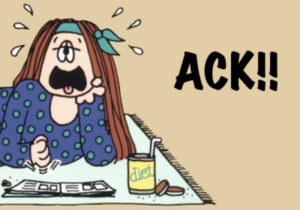
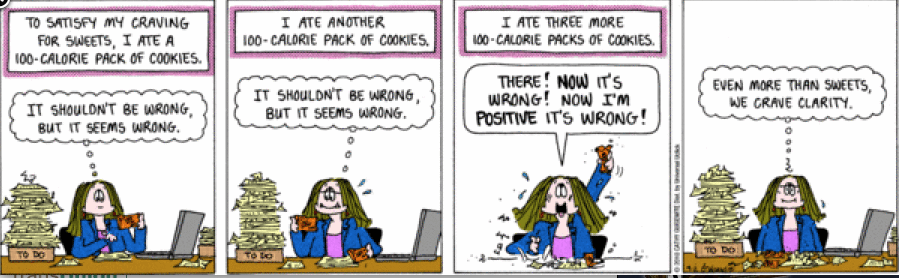
Remember that comic strip, Cathy? She was the pre-Bridget Jones, pre-Spice Girls feminist.

And she said ‘Ack!’ a lot.

Cathy was a regular feature in the 90s Sunday papers.  I looked forward to Dennis the Menace’s antics, the marital spats of the Lockhorns, and then there was Cathy.

I was too young to fully appreciate her wit and neuroses. I was baffled by her relationship with food and shopping, and yet, because it was a ‘comic’, I read it, thinking that it must be for children.

But it really wasn’t.

Cathy was dealing with relationship, work, food, and weight-related stress. She was a caricature of the 80s/90s woman. She was dealing with low self-esteem, at a time when women had to prove their worth and capability in the sphere of womanhood. Yet, as her mania invariably surfaced by the second frame, Cathy was an independent woman, who struggled with her independence.

I realise this now, as I look back on those comic strips. Just think of all that shopping she had to do, which then became another revelation that she was ‘over-weight’ by society’s (and her mother’s) standards.  Cathy was dependent on material things, and societal norms. Yet she had a good job, good friends, a stable relationship, and her parents were still in her life.

She may have been relatable for women of her age, but to an awkward preteen dealing with weird hair and oversized spectacles, Cathy was a strange creature.

Continue reading “A Woman for All Seasons”

Ode to a Deadline

There’s a reason it’s called a deadline; you die if you miss it. And for someone who chooses to write for recreation, and hopefully, make a living from it, the deadline is your Master. I’ve set myself a deadline of posting every Saturday, thus far it’s worked. However, this will only be my third post, and I have failed.

My writing process is unrefined, and generally relies on whatever I’m thinking for my writing week, which starts on a Tuesday evening. It kicks off with agonizing over relevance, and “can I articulate this thought into something comprehensive and witty?”

This is invariably followed by a scene from the television series, Black Books. Fran has a new job, but doesn’t know what she’s supposed to be doing. This is how she deals with it:

Whenever I’m at a loss for words, which is often, that scene, with Fran’s desperate typing, pops into my head, and then it’s okay.

And it’s cathartic somehow; that frantic typing, that utter wank on the screen. It helps unclog the passage from the brain to the fingers.

Continue reading “Ode to a Deadline”